

Check the Free demo of our MD-102 Exam Dumps with 330 Questions
Clear your concepts with MD-102 Questions Before Attempting Real exam
Microsoft MD-102 Exam Syllabus Topics:
| Topic | Details |
|---|---|
| Topic 1 |
|
| Topic 2 |
|
| Topic 3 |
|
| Topic 4 |
|
NEW QUESTION # 58
Hotspot Question
You have the devices shown in the following table.
You plan to implement Desktop Analytics.
You need to identify which devices support the following:
- Compatibility insights
- App usage insights
Which devices should you identify? To answer, select the appropriate options in the answer area.
NOTE: Each correct selection is worth one point.
Answer:
Explanation:
Explanation:
Box 1: Device1 and Device2 only
You can use the Compatibility Administrator Tool on the following operating systems:
Windows 10
Windows 8.1
Windows 8
Windows 7
Windows Server 2012
Windows Server 2008 R2
Box 2: Device1, Device2, Device3, and Device4
Application Insights adds support for iOS and Android apps.
Reference:
https://docs.microsoft.com/en-us/windows/deployment/planning/using-the-compatibility- administrator-tool
https://azure.microsoft.com/en-us/updates/application-insights-adds-support-for-ios-and-android- apps-improved-java-app-support-and-fine-time-selection/
NEW QUESTION # 59
You have a Microsoft 365 subscription that contains a user named User1. The subscription contains devices enrolled in Microsoft intune as shown in the following table.
Microsoft Edge is available on all the devices.
Intune has the device compliance policies shown in the following table.
The Compliance policy settings are configured as shown in the exhibit. (Click the Exhibit tab.) You create the following Conditional Access policy:
* Name: Policy1
* Assignments
o Users and groups: User1
o Cloud apps or actions: Office 365 SharePoint Online
* Access controls
o Grant Require device to be marked as compliant
* Enable policy: On
For each of the following statements, select Yes if the statement is true. Otherwise, select No. NOTE: Each correct selection is worth one point.
Answer:
Explanation:
NEW QUESTION # 60
You have an Azure AD group named Group1. Group! contains two Windows 10 Enterprise devices named Device1 and Device2. You create a device configuration profile named Profile1. You assign Profile! to Group1. You need to ensure that Profile! applies to Device1 only. What should you modify in Profile 1?
- A. Applicability Rules
- B. Assignments
- C. Scope (Tags)
- D. Settings
Answer: A
Explanation:
To ensure that Profile1 applies to Device1 only, you need to modify the Applicability Rules in Profile1. You can use applicability rules to filter which devices receive a profile based on criteria such as device model, manufacturer, or operating system version. You can create an applicability rule that matches Device1's properties and excludes Device2's properties. References:
https://docs.microsoft.com/en-us/mem/intune/configuration/device-profile-assign#applicability-rules
NEW QUESTION # 61
You have a Microsoft Deployment Toolkit (MDT) solution that is used to manage Windows 11 deployment tasks.
MDT contains the operating system images shown in the following table.
You need to perform a Windows 11 in-place upgrade on several computers that run Windows 10.
From the Deployment Workbench, you open the New Task Sequence Wizard.
You need to identify which task sequence template and which operating system image to use for the task sequence. The solution must minimize administrative effort.
What should you identify? To answer, select the appropriate options in the answer area.
NOTE: Each correct selection is worth one point.
Answer:
Explanation:
Explanation:
Box 1: Standard Client Upgrade Task Sequence
Use Template: Standard Client Upgrade Task Sequence
In-place upgrade is the preferred method to use when migrating from Windows 10 to a later release of Windows 10, and is also a preferred method for upgrading from Windows 7 or 8.1 if you do not plan to significantly change the device's configuration or applications. MDT includes an in-place upgrade task sequence template that makes the process really simple.
Box 2: Install.wim
In-place upgrade differs from computer refresh in that you cannot use a custom image to perform the in-place upgrade. I Reference:
https://docs.microsoft.com/en-us/windows/deployment/deploy-windows-mdt/upgrade-to-windows-10-with-the-m
NEW QUESTION # 62
You have a Microsoft 365 subscription.
All users have Microsoft 365 apps deployed.
You need to configure Microsoft 365 apps to meet the following requirements:
* Enable the automatic installation of WebView2 Runtime.
* Prevent users from submitting feedback.
Which two settings should you configure in the Microsoft 365 Apps admin center? To answer, select the appropriate settings in the answer area.
NOTE: Each correct selection is worth one point.
Answer:
Explanation:
Explanation
D:\mudassar\Untitled.jpg
NEW QUESTION # 63
You have a Microsoft 365 E5 subscription and a computer that runs Windows 11.
You need to create a customized installation of Microsoft 365 Apps for enterprise.
Which four actions should you perform in sequence? To answer, move the appropriate cmdlets from the list of cmdlets to the answer area and arrange them in the correct order.
Answer:
Explanation:
1 - Download ODT application
2 - Create a configuration file (XML)
3 - setup.exe /download to download the installation files
4 - setup.exe /configure to deploy the application
NEW QUESTION # 64
-
You have a Microsoft 365 subscription. The subscription contains 1,000 computers that run Windows 11 and are enrolled in Microsoft Intune.
You plan to create a compliance policy that has the following options enabled:
* Require Secure Boot to be enabled on the device.
* Require the device to be at or under the machine risk score.
Which two Compliance settings should you configure? To answer, select the appropriate settings in the answer area.
NOTE: Each correct selection is worth one point.
Answer:
Explanation:
Explanation:
Device health
https://learn.microsoft.com/en-us/mem/intune/enrollment/windows-enrollment-status Microsoft Defender for Endpoint
https://learn.microsoft.com/en-us/mem/intune/protect/compliance-policy-create-windows#microsoft-defender-fo
NEW QUESTION # 65
You have a Microsoft Intune deployment that contains the resources shown in the following table.
You create a policy set named Set1 and add Comply1 to Set1.
Which additional resources can you add to Set1?
- A. Comply2, CA1, Conf1, and Office1
- B. Comply2 only
- C. Conf1 only
- D. Comply2 and Conf1 only
- E. CA1, Conf1, and Office1 only
Answer: D
Explanation:
https://learn.microsoft.com/en-us/mem/intune/fundamentals/policy-sets
NEW QUESTION # 66
You have an Azure AD tenant named contoso.com that contains a user named Used. User! has a user principal name (UPN) of [email protected].
You join a Windows 11 device named Client 1 to contoso.com.
You need to add User1 to the local Administrators group of Client1.
How should you complete the command? To answer, select the appropriate options in the answer area.
NOTE: Each correct selection is worth one point.
Answer:
Explanation: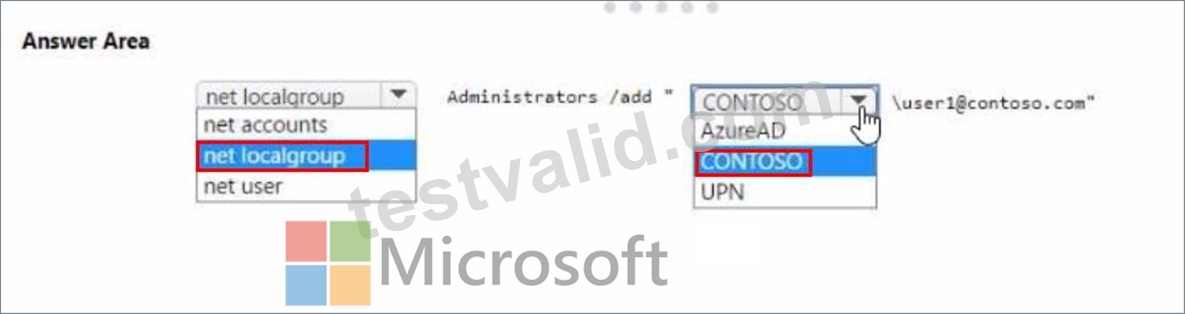
NEW QUESTION # 67
You have a Microsoft 365 subscription that contains two users named User1 and User2. You need to ensure that the users can perform the following tasks:
* User1 must be able to create groups and manage users.
* User2 must be able to reset passwords for no administrative users.
The solution must use the principle of least privilege.
Which role should you assign to each user? To answer, drag the appropriate roles to the correct users. Each role may be used once, more than once, or not at all. You may need to drag the split bar between panes or scroll to view content.
NOTE: Each correct selection is worth one point.
Answer:
Explanation:
Explanation:
Microsoft 365 or Office 365 subscription comes with a set of admin roles that you can assign to users in your organization using the Microsoft 365 admin center. Each admin role maps to common business functions and gives people in your organization permissions to do specific tasks in the admin centers1.
To ensure that User1 can create groups and manage users, you should assign the User Administrator role to User1. This role allows User1 to create and manage all aspects of users and groups, including resetting passwords for non-administrative users1.
To ensure that User2 can reset passwords for non-administrative users, you should assign the Helpdesk Administrator role to User2. This role allows User2 to reset passwords, manage service requests, and monitor service health for non-administrative users1.
NEW QUESTION # 68
Your company standardizes on Windows 10 Enterprise for all users.
Some users purchase their own computer from a retail store. The computers run Windows 10 Pro.
You need to recommend a solution to upgrade the computers to Windows 10 Enterprise, join the computers to Azure AD, and install several Microsoft Store apps. The solution must meet the following requirements:
* Ensure that any applications installed by the users are retained.
* Minimize user intervention.
What is the best recommendation to achieve the goal?
More than one answer choice may achieve the goal.
Select the BEST answer.
- A. Windows Autopilot
- B. a Windows Configuration Designer provisioning package
- C. Microsoft Deployment Toolkit (MDT)
- D. Windows Deployment Services (WDS)
Answer: A
NEW QUESTION # 69
Your company has a computer named Computer1 that runs Windows 10.
Computed was used by a user who left the company.
You plan to repurpose Computer1 and assign the computer to a new user.
You need to redeploy Computer1 by using Windows Autopilot.
Which three actions should you perform in sequence? To answer, move the appropriate actions from the list of actions to the answer area and arrange them in the correct order.
Answer:
Explanation:
1 - Generate a JSON file that contains the computer information.
2 - Reset the computer.
3 - Upload the file by running azcopy.exe
NEW QUESTION # 70
You use Windows Admin Center to remotely administer computers that run Windows 10.
When connecting to Windows Admin Center, you receive the message shown in the following exhibit.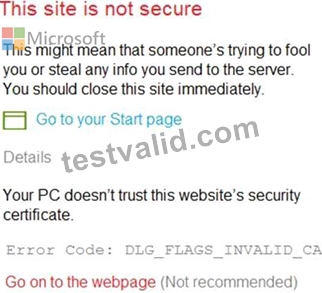
You need to prevent the message from appearing when you connect to Windows Admin Center.
To which certificate store should you import the certificate?
- A. Trusted Root Certification Authorities
- B. Client Authentication Issuers
- C. Personal
Answer: A
NEW QUESTION # 71
You have a computer named Computer1 that runs Windows 10.
Computer1 is used by a user named User1.
You need to ensure that when User1 opens websites from untrusted locations by using Microsoft Edge, Microsoft Edge runs in an isolated container.
What should you do first?
- A. From Windows Features, turn on Windows Defender Application Guard.
- B. From Windows Security, configure the Device security settings.
- C. From Windows Features, turn on Hyper-V Platform.
- D. From Windows Security, configure the Virus & threat protection settings.
Answer: A
Explanation:
For Microsoft Edge, Application Guard helps to isolate enterprise-defined untrusted sites, protecting your company while your employees browse the Internet. As an enterprise administrator, you define what is among trusted web sites, cloud resources, and internal networks. Everything not on your list is considered untrusted. If an employee goes to an untrusted site through either Microsoft Edge or Internet Explorer, Microsoft Edge opens the site in an isolated Hyper-V- enabled container.
Reference:
https://docs.microsoft.com/en-us/windows/security/threat-protection/windows-defender- application-guard/wd-app-guard-overview https://docs.microsoft.com/en- us/windows/security/threat-protection/windows-defender-application-guard/install-wd-app-guard
NEW QUESTION # 72
Your company has a Microsoft 365 subscription.
A new user named Admin1 is responsible for deploying Windows 10 to computers and joining the computers to Microsoft Azure Active Directory (Azure AD).
Admin1 successfully joins computers to Azure AD.
Several days later, Admin1 receives the following error message: "This user is not authorized to enroll. You can try to do this again or contact your system administrator with the error code (0x801c0003)." You need to ensure that Admin1 can join computers to Azure AD and follow the principle of least privilege.
- A. Modify the User settings in Azure AD.
- B. Modify the Device settings in Azure AD.
- C. Assign the Cloud device administrator role to Admin1.
- D. Assign the Global administrator role to Admin1.
Answer: B
Explanation:
If you have rights to manage devices in Intune, you can manage devices for which mobile device management is listed as Microsoft Intune. If the device isn't enrolled with Microsoft Intune, the Manage option won't be available.
Note: Enable or disable an Azure AD device
There are two ways to enable or disable devices:
The toolbar on the All devices page, after you select one or more devices.
The toolbar, after you drill down for a specific device.
Reference:
https://docs.microsoft.com/en-us/azure/active-directory/devices/device-management-azure-portal
NEW QUESTION # 73
Your on-premises network contains an Active Directory Domain Services (AD DS) domain named contoso.com.
The domain contains a domain controller named dc1.contoso.com.
You have a Microsoft 365 E5 subscription that uses Microsoft Intune Suite.
You have an Azure subscription that contains the resources shown in the following table.
The subscription contains the virtual networks shown in the following table.
You plan to deploy Windows 365 Enterprise Cloud PC.
You need to create an Azure network connection (ANC) that will use Microsoft Entra hybrid join.
Which virtual network can you use for the ANC?
- A. VNet3 only
- B. VNet2 only
- C. VNet1 and VNet2
- D. VNet1 only
- E. VNet1 and VNet3
Answer: D
NEW QUESTION # 74
Your network contains an on-premises Active Directory Domain Services (AD DS) domain that syncs with an Azure AD tenant. The tenant contains the users shown in the following table.
You assign Windows 10/11 Enterprise E5 licenses to Gtoup1 and Uset2.
You deploy the devices shown in the following table.
For each of the following statements, select Yes if the statement is true. Otherwise, select No.
NOTE: Each correct selection is worth one point.
Answer:
Explanation:
NEW QUESTION # 75
You have a Microsoft 365 subscription that uses Microsoft Intune.
You plan to manage Windows updates by using Intune.
You create an update ring for Windows 10 and later and configure the User experience settings for the ring as shown in the following exhibit.
Use the drop-down menus to select the answer choice that completes each statement based on the information presented in the graphic.
NOTE: Each correct selection is worth one point.
Answer:
Explanation:
NEW QUESTION # 76
Note: This question is part of a series of questions that present the same scenario. Each question in the series contains a unique solution that might meet the stated goals. Some question sets might have more than one correct solution, while others might not have a correct solution.
After you answer a question in this section, you will NOT be able to return to it. As a result, these questions will not appear in the review screen.
You have an Azure Directory group named Group1 that contains Windows 10 Enterprise devices and Windows 10 Pro devices.
From Microsoft Intune, you create a device configuration profile named Profile1.
You need to ensure that Profile1 applies to only the Windows 10 Enterprise devices in Group1.
Solution: You configure an applicability rule for Profile1. You assign Profile1 to Group1.
Does this meet the goal?
- A. No
- B. Yes
Answer: B
Explanation:
Applicability rules allow administrators to target devices in a group that meet specific criteria. For example, you create a device restrictions profile that applies to the All Windows 10/11 devices group. And, you only want the profile assigned to devices running Windows Enterprise.
To do this task, create an applicability rule.
Reference:
https://docs.microsoft.com/en-us/mem/intune/configuration/device-profile-create
NEW QUESTION # 77
......
Get professional help from our MD-102 Dumps PDF: https://passtorrent.testvalid.com/MD-102-valid-exam-test.html