

Latest PCNSA Actual Free Exam Updated 361 Questions
Online Questions - Valid Practice PCNSA Exam Dumps Test Questions
The PCNSA exam is a rigorous test that requires candidates to have a solid understanding of network security concepts and technologies. It includes multiple-choice questions and requires a passing score of 70%. PCNSA exam is administered by Pearson VUE and can be taken at any of their testing centers around the world.
Exam Topics
The PCNSA exam measures your abilities in deploying, configuring, and operating the Palo Alto Networks product portfolio components, understanding the unique features of the Palo Alto Networks product portfolio, as well as understanding security and networking policies utilized by PAN-OS software. All the technical skills evaluated by the certification test are grouped into six domains that have different weights in the exam content. The specific abilities included in these topics are outlined below:
- Deployment Optimization (4%)
This topic covers skills in determining the advantages as well as differences between BPA and Heatmap reports.
- Traffic Visibility (20%)
This section requires the individuals’ skills in selecting the proper application-based security policy regulations depending on a scenario; customizing application groups or application filters depending on a scenario; defining the function of application features as indicated in the App-ID database; searching the potential effect of App-ID upgrades on the current security policy regulations; finding the techniques to improve security policies; defining the features utilized to facilitate the creation of App-ID policy.
- Securing Traffic (18%)
This subject area requires your competencies in defining and implementing the proper security profile depending on a risk scenario; defining the difference between security profile actions & security policy actions; defining how to configure security profiles depending on a network scenario; determining the firewall’s defense from protocol-based and packet- attacks; defining how the firewall can utilize the Cloud DNS database to regulate traffic on the basis of domains; finding how the firewall can utilize the PAN-DB database to regulate traffic on the basis of websites; describing how to regulate access to particular URLs with the help of custom URL filtering types.
- Identifying Users (12%)
In the framework of this area, the students need to prove that they are able to define the proper approach to map IP addresses to usernames depending on a scenario; define the proper User-ID agent to deploy depending on a scenario; define how the firewall maps usernames to user groups; define User-ID configuration options depending on a graphic.
The PCNSA exam covers a broad range of topics related to network security, including network security design, firewall configuration, threat prevention, VPN configuration, and management.
NEW QUESTION # 145
Given the screenshot, what are two correct statements about the logged traffic? (Choose two.)
- A. The traffic was denied by URL filtering.
- B. The web session was decrypted.
- C. The traffic was denied by security profile.
- D. The web session was unsuccessfully decrypted.
Answer: A,B
NEW QUESTION # 146
Match the Palo Alto Networks Security Operating Platform architecture to its description.
Answer:
Explanation:
NEW QUESTION # 147
Match the network device with the correct User-ID technology.
Answer:
Explanation:
Explanation
Microsoft Exchange - Server monitoring
Linux authentication - syslog monitoring
Windows Client - client probing
Citrix client - Terminal Services agent
NEW QUESTION # 148
Which two features can be used to tag a user name so that it is included in a dynamic user group? (Choose two)
- A. XML API
- B. log forwarding auto-tagging
- C. User-ID Windows-based agent
- D. GlobalProtect agent
Answer: A,C
Explanation:
https://docs.paloaltonetworks.com/pan-os/8-1/pan-os-admin/url-filtering/url-filtering-concepts/url-filtering-profil
NEW QUESTION # 149
Based on the show security policy rule would match all FTP traffic from the inside zone to the outside zone?
- A. engress outside
- B. inside-portal
- C. intercone-default
- D. internal-inside-dmz
Answer: A
NEW QUESTION # 150
What is a recommended consideration when deploying content updates to the firewall from Panorama?
- A. Before deploying content updates, always check content release version compatibility.
- B. Content updates for firewall A/A HA pairs need a defined master device.
- C. After deploying content updates, perform a commit and push to Panorama.
- D. Content updates for firewall A/P HA pairs can only be pushed to the active firewall.
Answer: A
Explanation:
The content release version on the Panorama management server must be the same (or earlier) version as the content release version on any Dedicated Log Collectors or managed firewalls.
https://docs.paloaltonetworks.com/panorama/9-1/panorama-admin/set-up-panorama/install- content-and-software-updates-for-panorama/panorama-log-collector-firewall-and-wildfire-version- compatibility#id09d0b616-1197-4f80-be05-fdd7e75f8652
NEW QUESTION # 151
Which statement best describes a common use of Policy Optimizer?
- A. Policy Optimizer can add or change a Log Forwarding profile for each Security policy selected.
- B. Policy Optimizer can display which Security policies have not been used in the last 90 days
- C. Policy Optimizer on a VM-50 firewall can display which Layer 7 App-ID Security policies have unused applications
- D. Policy Optimizer can be used on a schedule to automatically create a disabled Layer 7 App-ID Security policy for every Layer 4 policy that exists Admins can then manually enable policies they want to keep and delete ones they want to remove
Answer: B
Explanation:
https://docs.paloaltonetworks.com/prisma/prisma-access/prisma-access-cloud-managed- admin/create-prisma-access-policy/policy-optimizer
NEW QUESTION # 152
Which action results in the firewall blocking network traffic without notifying the sender?
- A. Deny
- B. Reset Client
- C. Drop
- D. Reset Server
Answer: C
Explanation:
The difference between deny and drop is that deny will make a router (or other device) send an ICMP type 3 (destination unreachable) message response back, where drop will not notify the sending party that the device has be denied and just silently drop the traffic.
NEW QUESTION # 153
Which interface types are assigned to IEEE 802.1Q VLANs?
- A. Layer 2 subinterfaces
- B. Tunnel interfaces
- C. Loopback interfaces
- D. Layer 3 subinterfaces
Answer: A
Explanation:
IEEE 802.1Q is a standard for VLAN tagging in Ethernet networks. In Cisco IOS, VLANs are typically assigned to Layer 2 subinterfaces, which are logical interfaces that allow a physical interface to be divided into multiple virtual interfaces. Each Layer 2 subinterface can be assigned a unique VLAN ID, allowing traffic to be separated and managed based on VLAN membership.
NEW QUESTION # 154
Based on the screenshot presented which column contains the link that when clicked opens a window to display all applications matched to the policy rule?
- A. Name
- B. Apps Seen
- C. Service
- D. Apps Allowed
Answer: B
NEW QUESTION # 155
An administrator is investigating a log entry for a session that is allowed and has the end reason of aged-out.
Which two fields could help in determining if this is normal? (Choose two.)
- A. Decrypted
- B. Packets sent/received
- C. IP Protocol
- D. Action
Answer: A,C
NEW QUESTION # 156
You receive notification about new malware that is being used to attack hosts. The malware exploits a software bug in common application.
Which Security Profile detects and blocks access to this threat after you update the firewall's threat signature database?
- A. Data Filtering Profile applied to outbound Security policy rules
- B. Antivirus Profile applied to outbound Security policy rules
- C. Vulnerability Protection Profile applied to inbound Security policy rules
- D. Data Filtering Profile applied to inbound Security policy rules
Answer: C
Explanation:
Vulnerability Protection Security Profiles stop attempts to exploit system flaws or gain unauthorized access to systems. Anti-Spyware Security Profiles identify infected hosts as traffic leaves the network, but Vulnerability Protection Security Profiles protect against threats entering the network.
For example, Vulnerability Protection Security Profiles protect against buffer overflows, illegal code execution, and other attempts to exploit system vulnerabilities.
NEW QUESTION # 157
Which statement is true regarding a Best Practice Assessment?
- A. It provides a percentage of adoption for each assessment area
- B. It provides a set of questionnaires that help uncover security risk prevention gaps across all areas of network and security architecture
- C. The assessment, guided by an experienced sales engineer, helps determine the areas of greatest risk where you should focus prevention activities
- D. The BPA tool can be run only on firewalls
Answer: A
Explanation:
Explanation/Reference: https://docs.paloaltonetworks.com/best-practices/8-1/data-center-best-practices/data-center-best- practice-security-policy/use-palo-alto-networks-assessment-and-review-tools
NEW QUESTION # 158
Based on the screenshot presented which column contains the link that when clicked opens a window to display all applications matched to the policy rule?
- A. Name
- B. Apps Seen
- C. Service
- D. Apps Allowed
Answer: B
NEW QUESTION # 159
Which object would an administrator create to enable access to all applications in the office-programs subcategory?
- A. application group
- B. application filter
- C. URL category
- D. HIP profile
Answer: B
NEW QUESTION # 160
Based on the security policy rules shown, ssh will be allowed on which port?
- A. 0
- B. 1
- C. 2
- D. 3
Answer: D
NEW QUESTION # 161
Which Security profile should be applied in order to protect against illegal code execution?
- A. Antivirus profile on allowed traffic
- B. Vulnerability Protection profile on allowed traffic
- C. Vulnerability Protection profile on denied traffic
- D. Antivirus profile on denied traffic
Answer: B
Explanation:
The Security profile that should be applied in order to protect against illegal code execution is the Vulnerability Protection profile on allowed traffic. The Vulnerability Protection profile defines the actions that the firewall takes to protect against exploits and vulnerabilities in applications and protocols. The firewall can block or alert on traffic that matches a specific threat signature or a group of threats. The Vulnerability Protection profile can prevent illegal code execution by detecting and blocking attempts to exploit buffer overflows, format string vulnerabilities, or other code injection techniques1. To apply the Vulnerability Protection profile on allowed traffic, you need to:
Create or modify a Vulnerability Protection profile on the firewall or Panorama and configure the rules and exceptions for the threats that you want to protect against2.
Attach the Vulnerability Protection profile to a Security policy rule that allows traffic that you want to scan for vulnerabilities3.
Commit the changes to the firewall or Panorama and the managed firewalls.
References: Vulnerability Protection Profile, Create a Vulnerability Protection Profile, Attach a Vulnerability Protection Profile to a Security Policy Rule, Certifications - Palo Alto Networks, Palo Alto Networks Certified Network Security Administrator (PAN-OS 10.0) or [Palo Alto Networks Certified Network Security Administrator (PAN-OS 10.0)].
NEW QUESTION # 162
An administrator would like to override the default deny action for a given application and instead would like to block the traffic and send the ICMP code "communication with the destination is administratively prohibited" Which security policy action causes this?
- A. Drop, send ICMP Unreachable
- B. Reset server
- C. Reset both
- D. Drop
Answer: A
NEW QUESTION # 163
Which action results in the firewall blocking network traffic with out notifying the sender?
- A. Deny
- B. Reset Client
- C. Drop
- D. Reset Server
Answer: C
NEW QUESTION # 164
Order the steps needed to create a new security zone with a Palo Alto Networks firewall.
Answer:
Explanation:
Explanation
Step 1 - Select network tab
Step 2 - Select zones from the list of available items
Step 3 - Select Add
Step 4 - Specify Zone Name
Step 5 - Specify Zone Type
Step 6 - Assign interfaces as needed
NEW QUESTION # 165 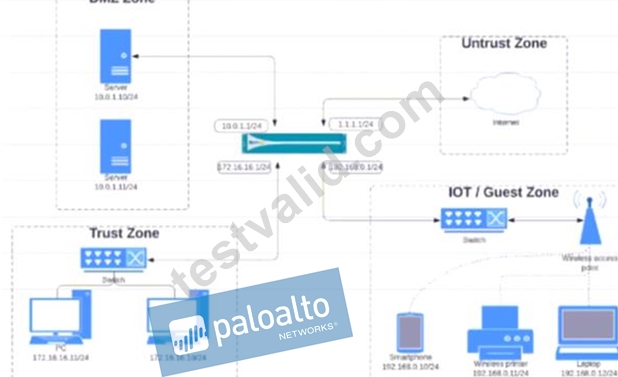
Given the network diagram, traffic should be permitted for both Trusted and Guest users to access general Internet and DMZ servers using SSH. web-browsing and SSL applications Which policy achieves the desired results?
A)
B)
C)
D)
- A. Option
- B. Option
- C. Option
- D. Option
Answer: A
NEW QUESTION # 166
Order the steps needed to create a new security zone with a Palo Alto Networks firewall.
Answer:
Explanation:
Explanation
Step 1 - Select network tab
Step 2 - Select zones from the list of available items
Step 3 - Select Add
Step 4 - Specify Zone Name
Step 5 - Specify Zone Type
Step 6 - Assign interfaces as needed
NEW QUESTION # 167
All users from the internal zone must be allowed only Telnet access to a server in the DMZ zone.
Complete the two empty fields in the Security policy rules that permits only this type of access. (Choose two.) Source Zone: Internal Destination Zone: DMZ Zone Application: _________?
Service: ____________?
Action: allow
- A. Service = "service-telnet"
- B. Application = "any"
- C. Service = "application-default"
- D. Application = "Telnet"
Answer: C,D
NEW QUESTION # 168
......
PCNSA Exam PDF [2024] Tests Free Updated Today with Correct 361 Questions: https://passtorrent.testvalid.com/PCNSA-valid-exam-test.html